
Turaida Forest Park has been created as a place where parents and children can find inspiration to explore nature, and where everyone can enjoy the refreshing beauty of the natural environment.
Accessibility: The forest park trails are covered with gravel and are accessible in all seasons. They are intended for pedestrians and can also be used with strollers. People in wheelchairs will need assistance from a companion. The forest park offers something interesting for visitors of all ages.
Trail length: 1.3 km, difficulty level: easy
Distance from the Visitor Center to Turaida Forest Park: 450 m
Duration: 1 hour
For a leisurely walk in Turaida Forest Park, it is recommended to allow at least 1 hour.
Description
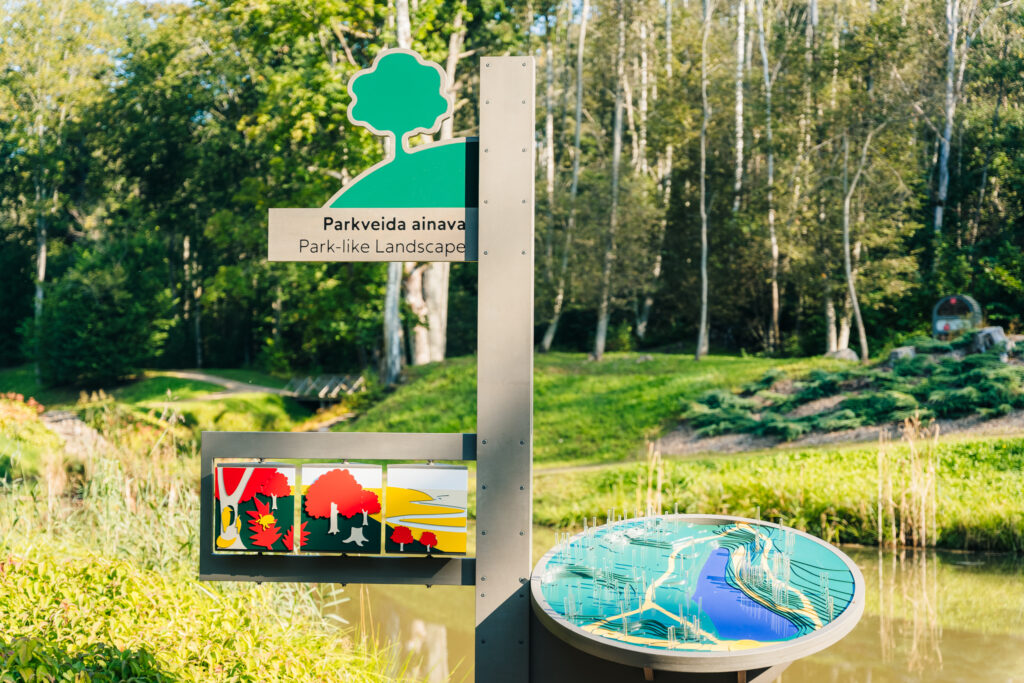
Turaida Forest Park covers 6.1 hectares of the total area of the Turaida Museum Reserve. It is a natural space with a pronounced landscape, featuring eight historical pond sites, a small river ravine, and natural tree growth.
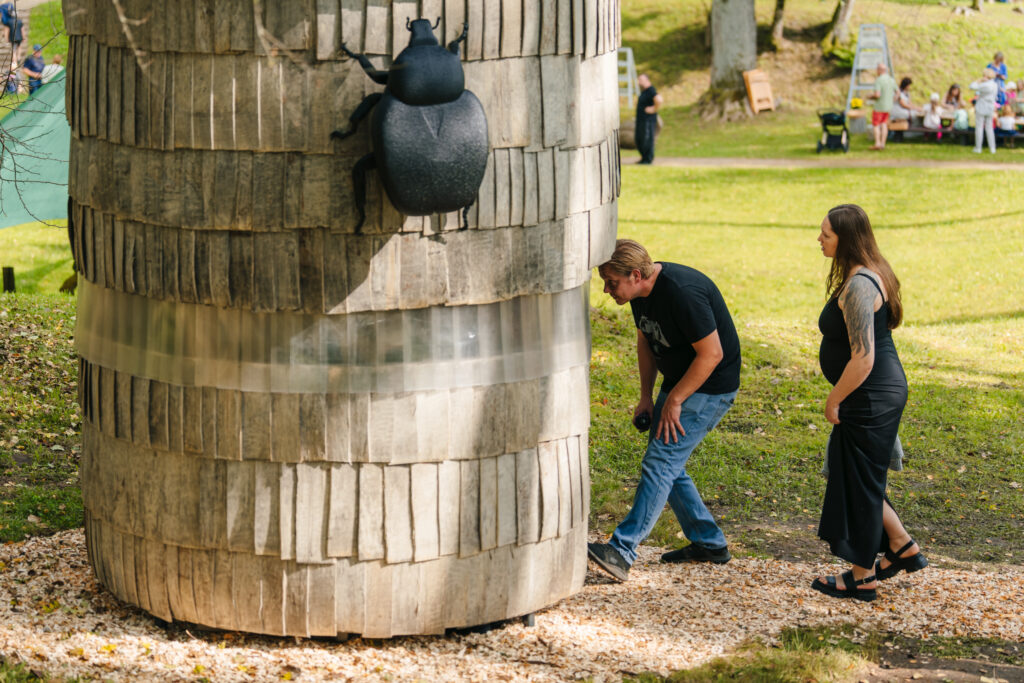
Three particularly notable trees stand out in the landscape—an oak, a wild apple tree, and a pine—each meeting the criteria of a protected “heritage tree.” Old deciduous trees provide suitable habitats for various insects, including the specially protected hermit beetle (Osmoderma barnabita).
The “Nature’s Pearls” exhibition consists of several parts:
Why create “insect hotels”?
Insect diversity is rapidly declining worldwide. Most plants would not be able to successfully produce seeds and fruits without the help of these small workers. Pollinators are responsible for pollinating at least 70% of crop species. In Latvia, around 6,000 insect species ensure plant pollination. The main ones are bees, butterflies, flies, and beetles.
To support biodiversity and help these hardworking assistants, “insect hotels” are being created more and more often. In Turaida Forest Park, very simple insect hotels have been set up—stacks of firewood. However, there is also a special “luxury hotel” built using materials recommended by insect researchers.
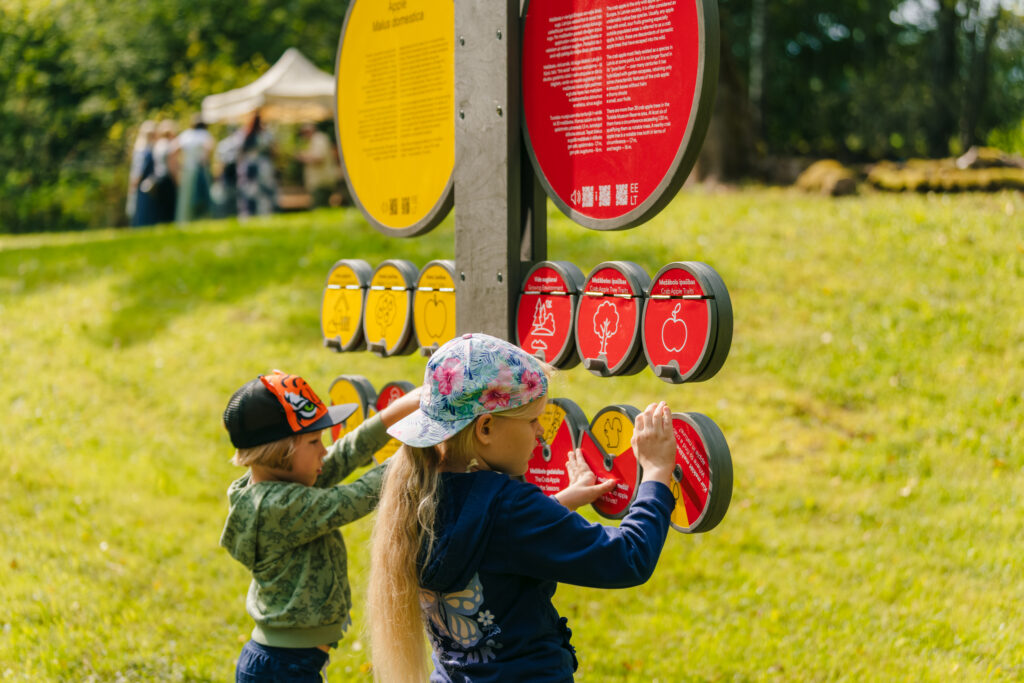
Wild apple tree – a garden escapee or a rare native species of Latvia?
Although in Latvia we often call all apple trees with sour fruits “wild apple trees,” the true wild apple tree, or otherwise known as crab apple tree in its “pure form” is almost no longer found here. Over the centuries, it has hybridized with cultivated apple trees, retaining only some of its characteristic features:
- The underside of the leaves is smooth
- The shoots may be thorny
- The fruit diameter does not exceed 4 cm
In the exhibition, you will learn how to distinguish a wild apple tree from a cultivated apple tree and see one of the six wild apple trees in the Turaida Museum Reserve that are considered heritage trees.
Latvia – the land of heritage trees
Heritage trees are the oldest and largest specimens of their species—important and outstanding elements of the landscape that showcase the beauty and grandeur of nature. They play a significant role in maintaining biodiversity.
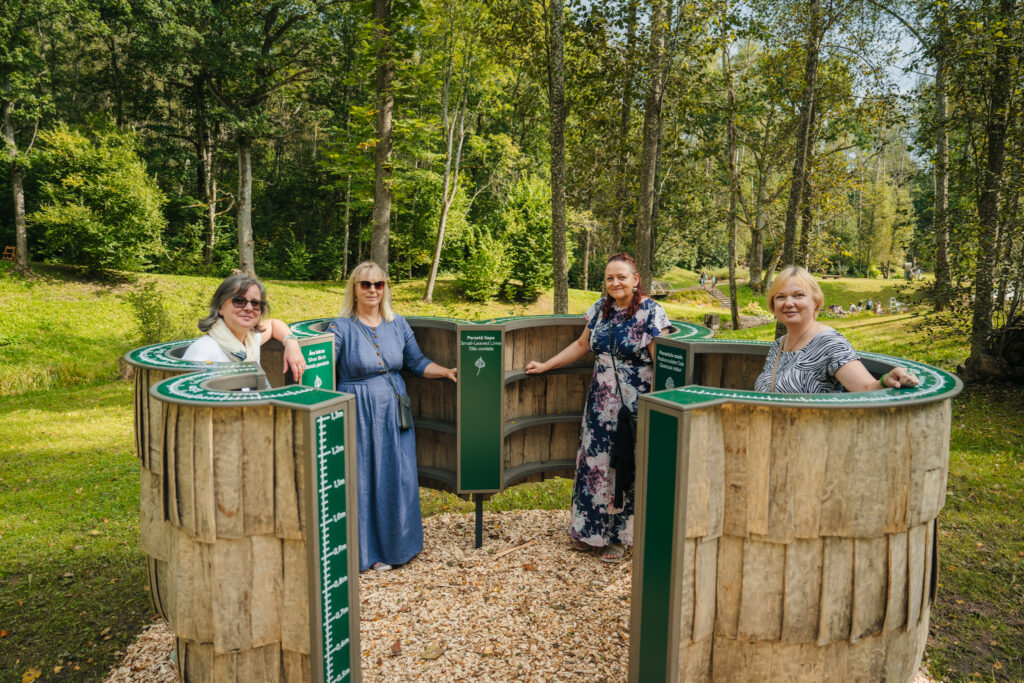
A tree gains heritage status by meeting one of two criteria: trunk circumference or height. Each species has its own threshold. The trunk circumference is measured at a height of 1.30 m from the root collar.
A heritage tree and its immediate surroundings form a specially protected natural area—not only the tree itself is protected, but also the area beneath its canopy and an additional 10-meter zone around it.
In Latvia, the Nature Conservation Agency awards heritage trees with a special sign or “order” in the shape of an oak leaf.
More than 15,000 heritage trees of national importance have been registered in Latvia. Over 20 of them grow in the Turaida Museum Reserve.
In Turaida Forest Park, a special “heritage tree measuring scale” has been created, where anyone can compare their size with that of a heritage tree.
What is an “umbrella species”?
An umbrella species is a species whose protection automatically safeguards many other plants and animals. By protecting one “key” species, we effectively cover all the others living alongside it—like an umbrella.
The main protected “hero” of Turaida Forest Park is a beetle from the scarab family—the hermit beetle (Osmoderma barnabita).
The hermit beetle prefers sunlit, old, hollow trees. If these old trees disappear, the beetle and many other species disappear as well. The presence of the hermit beetle indicates a high level of biodiversity in the area. It serves as an umbrella species for hundreds of animal and fungal species whose survival depends on old and hollow trees.
By protecting old trees, we help the hermit beetle and all its forest companions!
To learn more about the life of this mysterious beetle—take a peek inside its tree hollow!
Creators of the exhibition:
Turaida Museum Reserve:
Ija Kivlina – content author and curator
Gunta Zaķīte – project manager
Vija Stikāne – Deputy Director for Scientific Work
Scientific consultants:
Andrejs Svilāns (dendrology, Latvian National Botanical Garden)
Voldemārs Spuņģis (entomology, University of Latvia)
Maksims Balalaikins (entomology, Daugavpils University)
Zanda Segliņa (biologist, Nature Conservation Agency)
Design:
Architect Didzis Jaunzems (SIA DJA)
Budget:
Partially funded by the project “Garden Pearls for Everyone,” implemented within the INTERREG Estonia–Latvia cross-border cooperation program.